Visual arts
Pierre Keller

Pierre Keller (1945-2019) never played a single note in Montreux, and yet the image of the Montreux Jazz Festival owes him almost everything. A drawing teacher who became director of the ECAL, he obtained carte blanche on the festival poster from Claude Nobs in the early 1980s. He turned it into a contemporary art collection: Jean Tinguely, Keith Haring, Niki de Saint Phalle, Andy Warhol, Max Bill. He sat on the festival’s board of trustees, brought artists over from New York, drew up Lausanne’s nightlife, and died in July 2019 while the Musée Jenisch in Vevey was exhibiting his collection. He rests in Saint-Saphorin, beneath a headstone by the Bouroullec brothers, in a cemetery facing the lake where visitors are invited to sit down and raise a glass.
Pierre Keller, the man who made the poster a work of art
“You know nothing about art”
The line is his, and he liked to tell it. One day, he said, he told Claude Nobs: he himself knew nothing about music — his musical career had stopped in the Swiss army band — and Nobs knew nothing about art. The festival’s boss took the point. In the early 1980s, Pierre Keller took the poster in hand (SWI swissinfo).
The two men had known each other for forty years. They agreed on little, and were in league on the essential: that Montreux deserved better than an advertising hoarding.
1982, Jean Tinguely: “Draw me a festival”
The first to be called was Jean Tinguely. The brief fit in one sentence, which Keller liked to repeat: draw me a festival. Tinguely answered with a firework — a gouache set off by collage, with a yellow feather at its centre.
The poster was an immediate success, and it left more than an image behind: the Montreux Jazz Festival’s logo was born that year, from Tinguely’s handwritten lettering, reworked by Keller — and it has not changed since (Le Temps · Montreux Jazz Shop).
This is where Keller genuinely changed something. As current festival director Mathieu Jaton tells it: before him there were already fine productions, by the Montreux graphic designer Roger Bornand or the American Milton Glaser. Keller established something else — that the poster should no longer be a marketing product but a work of art.
Three rules followed, and have held ever since: no musician’s name on the poster, no sponsor’s logo, and a systematic screen print in the 70 × 100 cm format (Le Temps). The festival calls it carte blanche. It has lasted since 1982.
1983, Keith Haring: bringing over an unknown
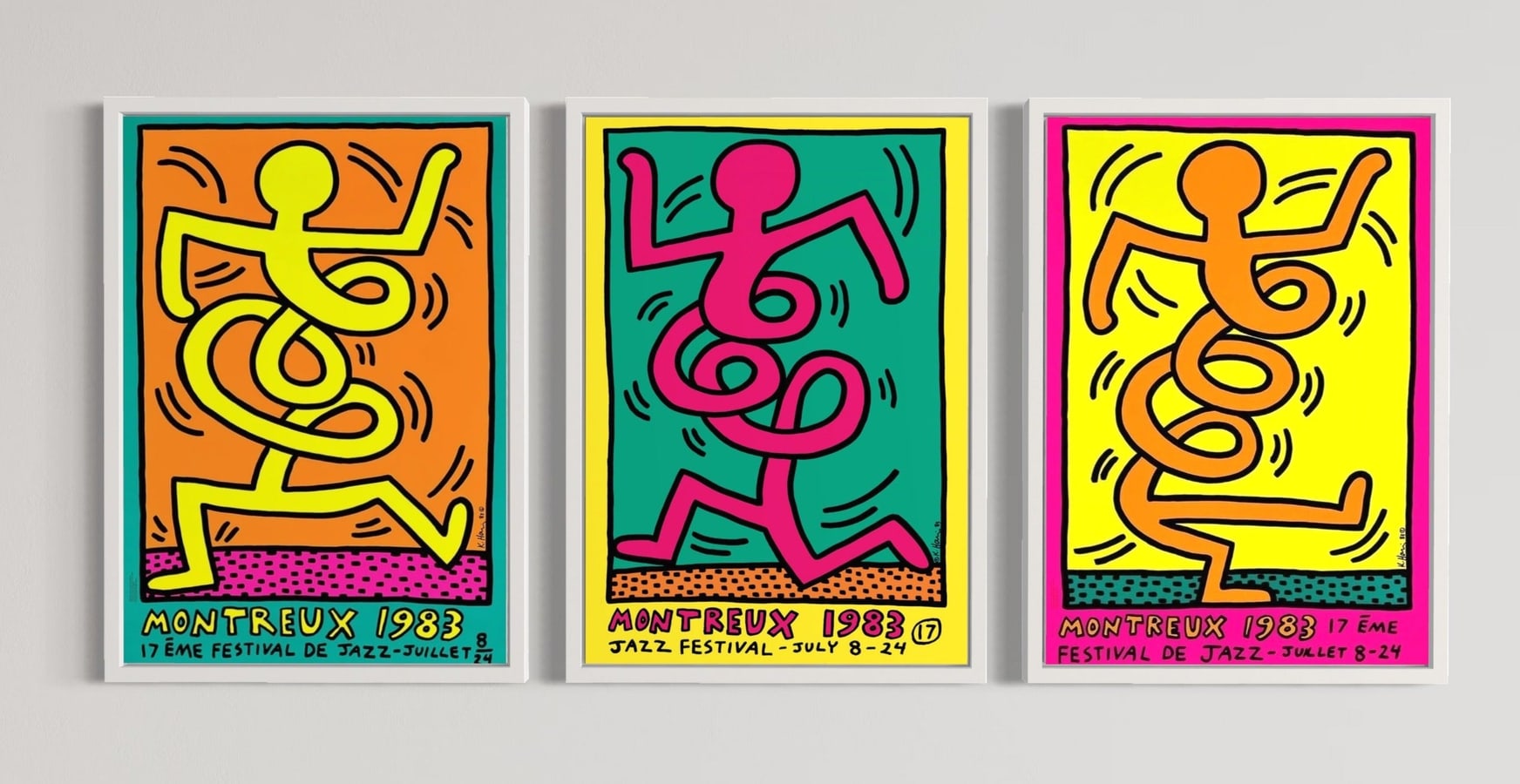
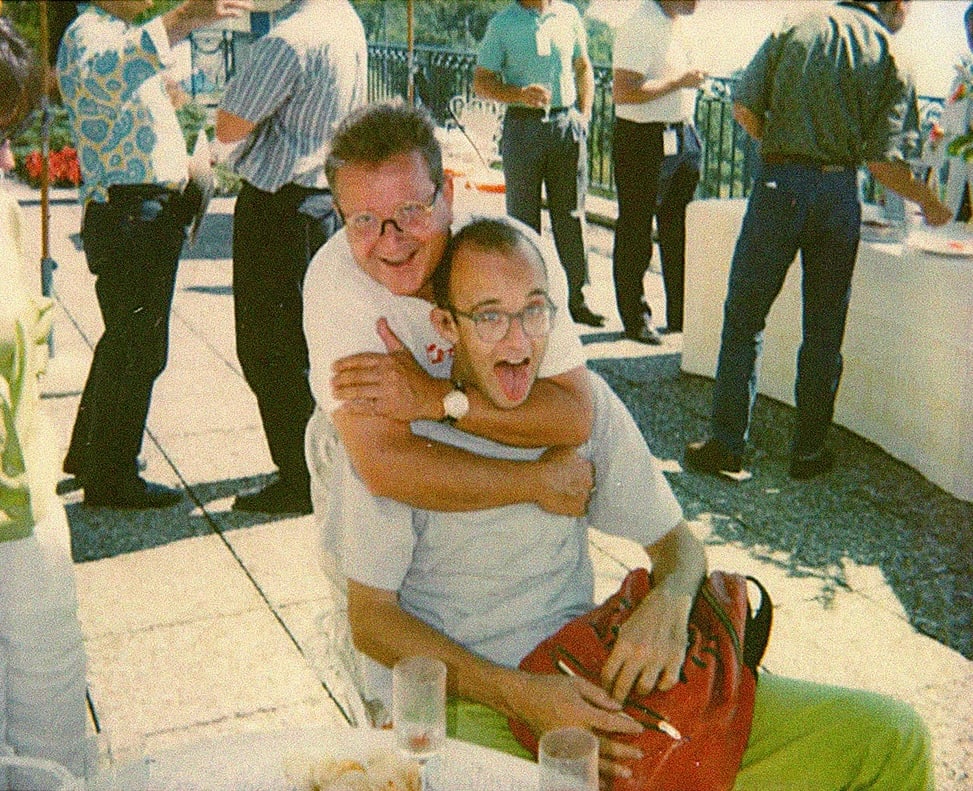
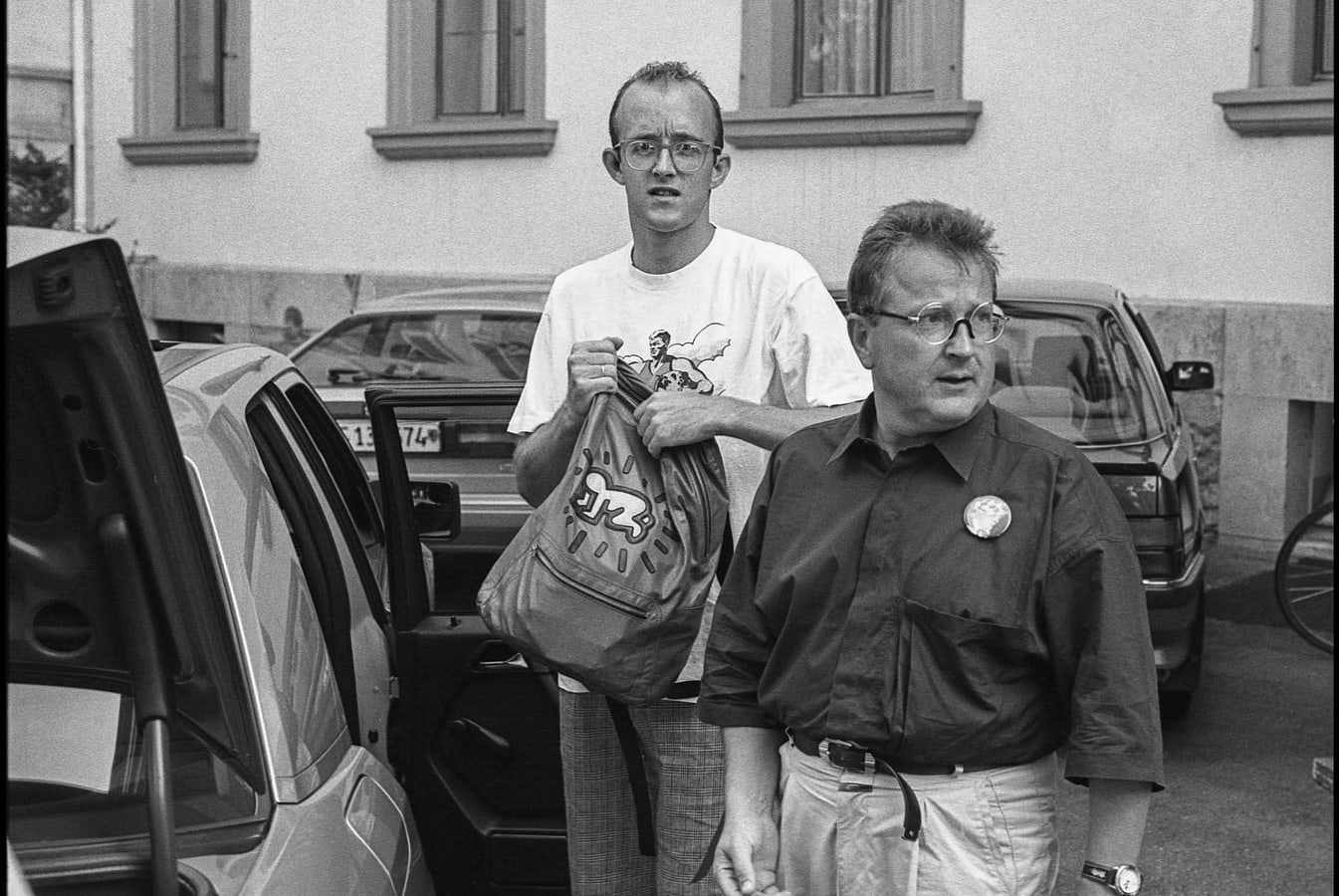
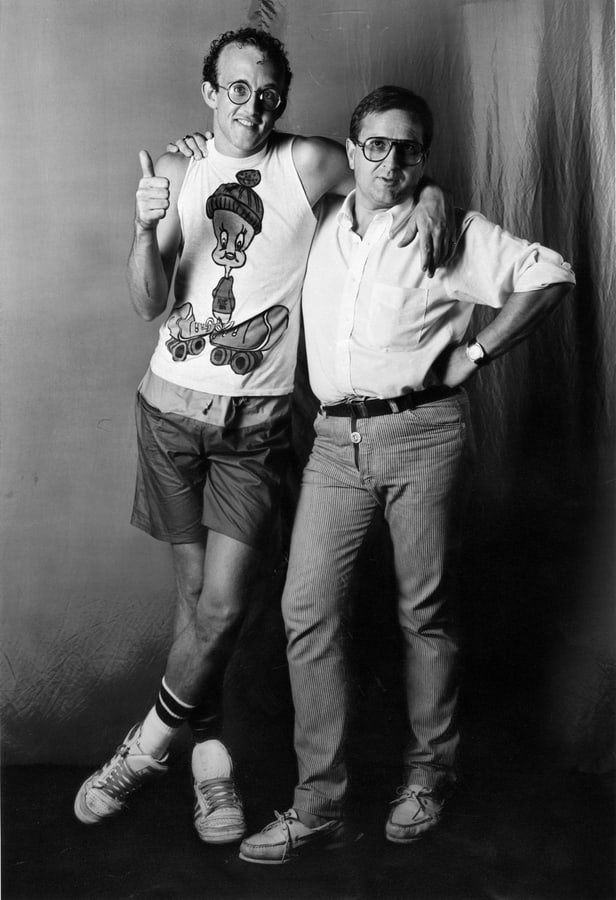
Keller met Keith Haring a few months after the American’s first solo show at Tony Shafrazi’s gallery in New York. Haring was twenty-five and had just come up from the subway. Keller invited him to Montreux and asked him for two things: a poster, and to cover the town.
Haring delivered three drawings, accepted at once and screen-printed in Bern. He then came, in April and again in July, and did what had been asked of him: the walls, the billboards, the T-shirts, a Land Rover. This episode has its own page, where you can find Keller’s correspondence, his projected budget of 24,670 francs, and the letter of 24 March 1983 sent to 325 Broome Street.
1984, Niki de Saint Phalle: one figure, two colours
The anecdote is Keller’s own, and it says something about his trade. Niki de Saint Phalle signed the 1984 poster. For Montreux, she painted a black woman. For the Montreux-Detroit Jazz Festival, the American twin city, the same figure turned pink: over there, the image simply could not pass as it stood (SWI swissinfo).
One work, two markets, two readings. Keller spent his life in that gap.
1986, Haring and Warhol: a Sunday in New York
For the festival’s twentieth anniversary, he wanted two or three artists together. He called Haring, who suggested Andy Warhol. Keller told the story of the trip without any drama: he arrived in New York on the Sunday morning, the three men met at the studio, fooled around a little, and he left on the Sunday evening with three projects.
The chosen poster was screen-printed by Albin Uldry, in Bern, at the house format. It celebrated the festival’s twentieth anniversary and Claude Nobs’s fiftieth birthday. Keller later explained his choice: an artist can make a very good drawing that will not make a good poster.
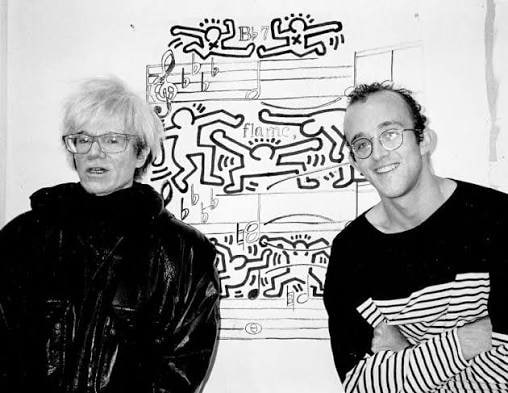
Warhol died in February 1987, Haring in February 1990. The Montreux poster remains one of their rare collaborations.
1995, David Bowie: the disagreement
Not everything ran smoothly. Keller disliked the idea of musicians signing the poster; Claude Nobs did not. In 1995 it was David Bowie who took it on, with an image evoking Hiroshima. Keller commented on the period with his usual bluntness: Claude was taking back the upper hand, with this urge — what an idea — to make posters with musicians.
Yet the same Keller had brought Bowie to engrave at the Gymnase du Bugnon in Lausanne, in the same workshops where Haring had drawn. The contradiction did not bother him.
From Gilly to ECAL
Pierre Keller was born on 9 January 1945 in Gilly, in the district of Nyon. His father was a house painter. He earned his graphic-design diploma at ECAL, the Vaud cantonal art school, in 1965 — and that same year bought his first work, a yellow screen print by Lucio Fontana, a Concetto spaziale. It would be the first piece in a collection of more than five hundred works.
He went on to represent Switzerland at the Warsaw Poster Biennial, the 9th Paris Biennial and the 17th São Paulo Biennial in 1983. The Federal Council appointed him to the Federal Commission for Fine Arts. From 1988 to 1991, the Vaud cantonal government put him in charge of organising the 700th anniversary of the Swiss Confederation.
The Gymnase du Bugnon, a parallel workshop
Before all that, he taught drawing — at the Aigle secondary school, then at the Gymnase du Bugnon in Lausanne. From 1979 he organised sessions there with guest artists. It was there that Haring would draw his Lucky Strike posters on 16 June 1987, and there that Bowie would come to engrave.
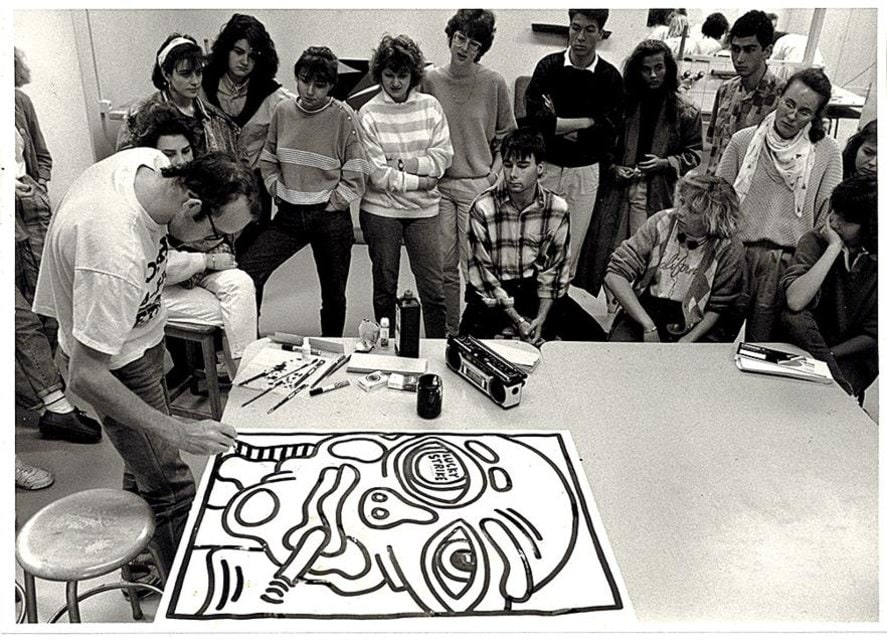
Keller worked without a fixed studio, often alongside his students and his artist friends. The Musée Jenisch would later sum him up this way: few people knew that before becoming a public figure, he had been a teacher, a publisher and a collector.
ECAL, 1995-2011
In 1995 he took over the direction of the Lausanne cantonal art school (ECAL), succeeding Jacques Monnier-Raball, who had run it for thirty years. He held no university degree. Within a few years, the school entered the European front rank. The EPFL appointed him full professor in 2004. He oversaw ECAL’s move to Renens, into an industrial building refurbished by the architect Bernard Tschumi.
That same year, 1995, he joined the Montreux Jazz Festival’s board of trustees, on which he would sit until his death.
Wine, the last life
On 30 June 2011, having reached retirement age, he left ECAL — reluctantly, the papers would write. He immediately bounced back to the presidency of the Vaud cantonal wine board, which he held until 2018. An outsized personality and an unabashed provocateur, recognisable by his high-pitched voice, he made no secret of his homosexuality at a time when Vaud’s institutional world was not used to it.
His honours tell the rest: the Fondation vaudoise pour la culture’s award for cultural influence in 2006, an honorary doctorate in Barcelona and the Design Preis Schweiz in 2007, the Prix de Lausanne in 2009, the Mérite culturel de Renens in 2010, Officer of the French Ordre des Palmes académiques and the Paris design promotion prize in 2011. He was an Officer of Arts and Letters.
January 2013: the death of Claude Nobs
When Claude Nobs died, on 10 January 2013, it was Keller whom RTS turned to, alongside the foundation’s president François Carrard. He spoke as a friend of forty years: we are losing a phenomenon, a unique character; the festival loses a bit of its soul.
Vevey, 2019: the collection, then the farewell
On 4 April 2019, the Musée Jenisch in Vevey opened “Friends, etc. La collection Pierre Keller”. About two hundred pieces chosen from the five hundred he owned: Fontana, Max Bill, Ben, Christo, Tinguely, Haring, Niki de Saint Phalle, Olivier Mosset, and a good deal of John M Armleder, his old accomplice, with whom he converses in the catalogue.
The exhibition was built around his obsessions: music — the Montreux Jazz and La Dolce Vita —, architecture, design, and wine. It is not an artist’s retrospective: it is the portrait of a viewer, and of a way of living with other people’s work.
He died on 7 July 2019 in Grandvaux, in the Lavaux, at 74, following surgery, after two years with liver cancer. The exhibition stayed open until 11 August: he had died in the middle of his own collection.
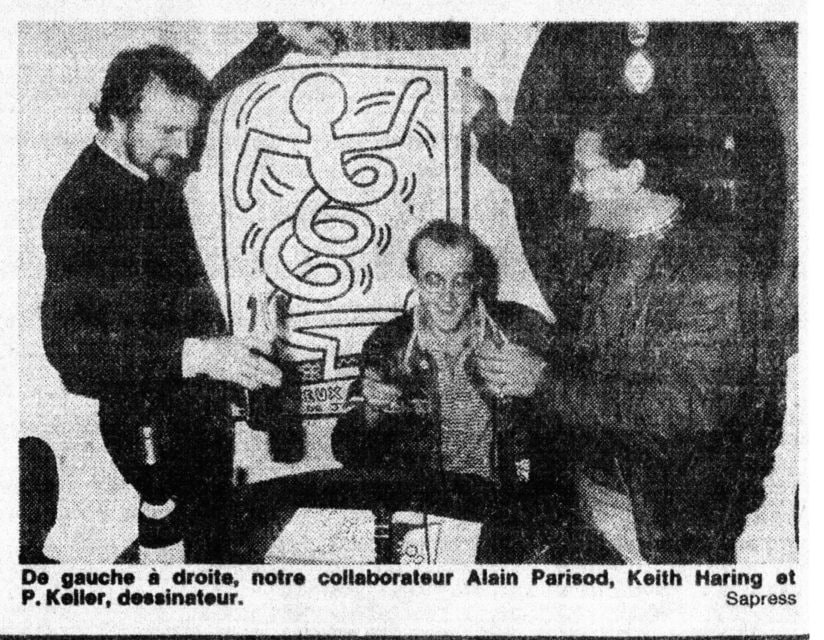
Thirty-six years earlier, on 9 April 1983, it was in that same village of Grandvaux that he had taken Keith Haring to a winegrower, Alain Parisod. The American had drawn a smiling bunch of grapes in the guest book. It is now the label of a wine.
Saint-Saphorin: a farewell in colour
The church at Saint-Saphorin was packed. The family’s instructions were clear: wear bright colours to bid farewell to a man who had lived, in his own words, a “colourful life”. Only the sky failed to comply.
His coffin had been decorated by John M Armleder, his oldest accomplice: white, crossed with coloured stripes recalling the rainbow flag. The ceremony, led by pastor Geneviève Butticaz, was meant as a festive occasion. There was art, and there was wine.
That same evening, in his cellar in Saint-Saphorin, a handful of villagers decided that something would have to be done.
24 September 2021: the headstone, the square and the wine press
Two years later, the commune unveiled three things on the same day, before around a hundred people.
The headstone, first, designed by Ronan and Erwan Bouroullec — the French designers Keller had commissioned and collected. No epitaph, no punchline, though everyone expected one of him. Just: Pierre Keller, 1945-2019.
The setting speaks for itself. Within a rectangle of gravel, the marble tomb is accompanied by a bench and a lantern designed to hold artworks — his own Kilo-Art was once shown there. The cemetery sits on a south-facing slope, with an open view over Lake Geneva and the Alps. Visitors are invited to sit, to look, and to drink a glass of chasselas (Le Temps).
It is probably the only grave on the Riviera that works both as an exhibition room and as a wine cellar for friends.
The square, next. Unable to rename a street, the commune gave his name to the small square on Chemin Neuf: Place Pierre-Keller, two hundred metres from the cemetery.
The wine press, finally. The old press standing on that square was “kellerised” by ECAL students, after the poster with which Keller had won the Brno Biennial in 1970. The pattern plays on the press’s rotation; the red and white recall both Lavaux wine and the colours of Saint-Saphorin (Le Courrier).
A third special vintage was brought up from the cellar for the occasion.
The adopted village
Saint-Saphorin was not a choice of burial place, it was his address. He kept his cellar there, he entertained there, and he had made a habit of gathering people over a bottle who had no reason to meet — winegrowers, designers, museum curators, festival bosses. RTS came to record him there in 2015, at the Auberge de l’Onde.
This village is already known to the site for another reason: it is from Saint-Saphorin that Freddie Mercury had his white wine shipped to London by the case. Two men who never crossed paths, two stories that end on the same hillside.
Videos
“Pierre Keller, a figure of typically Vaudois modesty”: an excerpt from the programme “Pardonnez-moi”, where Darius Rochebin interviewed him in May 2009, after the Prix de Lausanne. Rebroadcast by RTS on 8 July 2019, the day after his death.